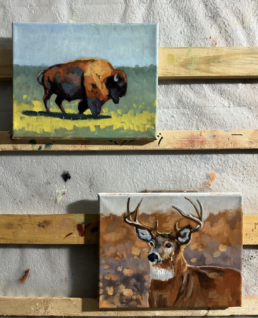


Small paintings have nowhere to hide. What does that mean?
At first glance, small paintings look to be easier to paint than big ones, right? A little 6×6 feels like something you can squeeze in between larger projects. Less surface to cover and fewer brushstrokes should mean less time.
But that’s often the myth.
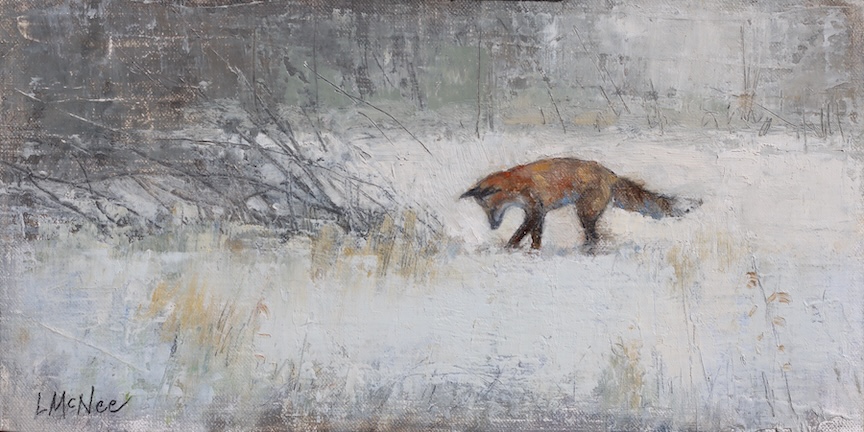
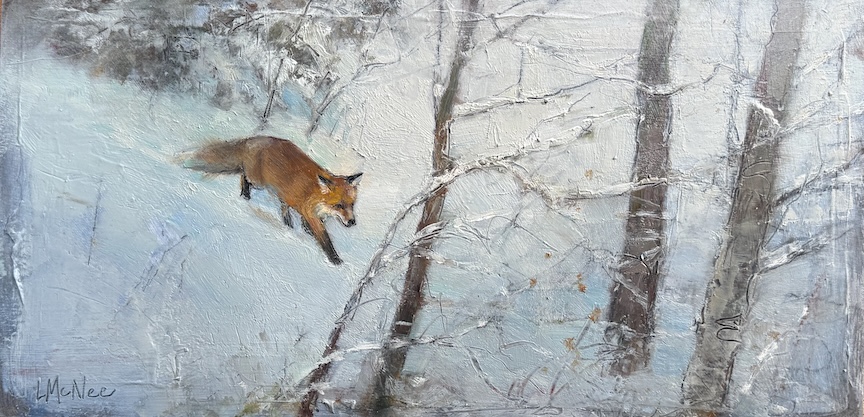
©2025 Lori McNee, “Frozen Dinner” 6×12, oil on canvas
Wide Open Spaces vs. Tiny Canvases
Big canvases always make me think of that Dixie Chicks song Wide Open Spaces: “wide open spaces, room to make a big mistake.”
That’s exactly what a larger canvas gives you. More room to roam, more room to adjust, and more room to recover when something goes sideways. Shapes can shift. Edges can soften. Whole passages can be redesigned without the painting falling apart.
Small paintings? Not so much. On a small substrate, every mark counts… and there’s nowhere to hide!
A Fox Painting Reminder
I was reminded of this recently while painting a little red fox on a 6×6 panel. I paint foxes often, so it should have been easy. Yet somehow, that tiny painting took 2 full days. Two days! (see painting to the right).
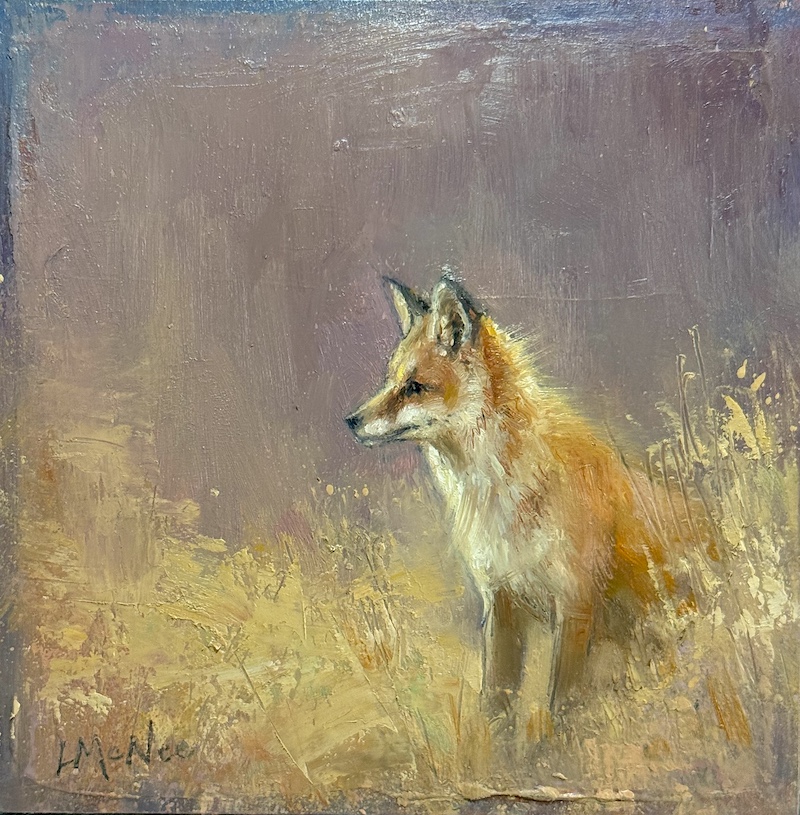
Trying to keep it loose and painterly while still making the fox believable was the real challenge. Even small “fixes” started messing it up, fast!
Eventually, I surrendered. I wiped off the fox and repainted it. And honestly? That reset was exactly what the painting needed. Everything came together quickly, and the painting, “Golden Thicket,” found its voice.
The Myth: “Small Means Easy”
A miniature painting isn’t simply a small version of a large one. Instead, small works often require more precision, more restraint, and sometimes a surprising amount of patience.
Why? Because when the canvas is small… everything gets amplified.
Why Small Paintings Can Be Tougher Than Big Ones
On a larger canvas, adjustments happen more naturally. There’s space to shift shapes, soften edges, and let areas breathe.
However, on a small painting, one tiny change can be the difference between “yes!” and “oh no…”
Here’s why:
1) Every Brushstroke Matters
On a 6×6, one brushstroke can become a whole statement. Because of that, corrections can’t be casual. Every mark shows, so each decision matters.
2) Edges Get Loud Fast
One edge that’s too hard can make the subject pop forward too much. On the other hand, too many soft edges can make it disappear completely. So, lost-and-found edges become even more important on small work.
3) Value Patterns Matter Even More
In small paintings, strong value organization does the heavy lifting. A clear value pattern guides the viewer’s eye. Clear values help create depth and a focal point.
Without strong values, the piece can feel confusing or busy, especially at a smaller scale.
4) Proportions Are Unforgiving
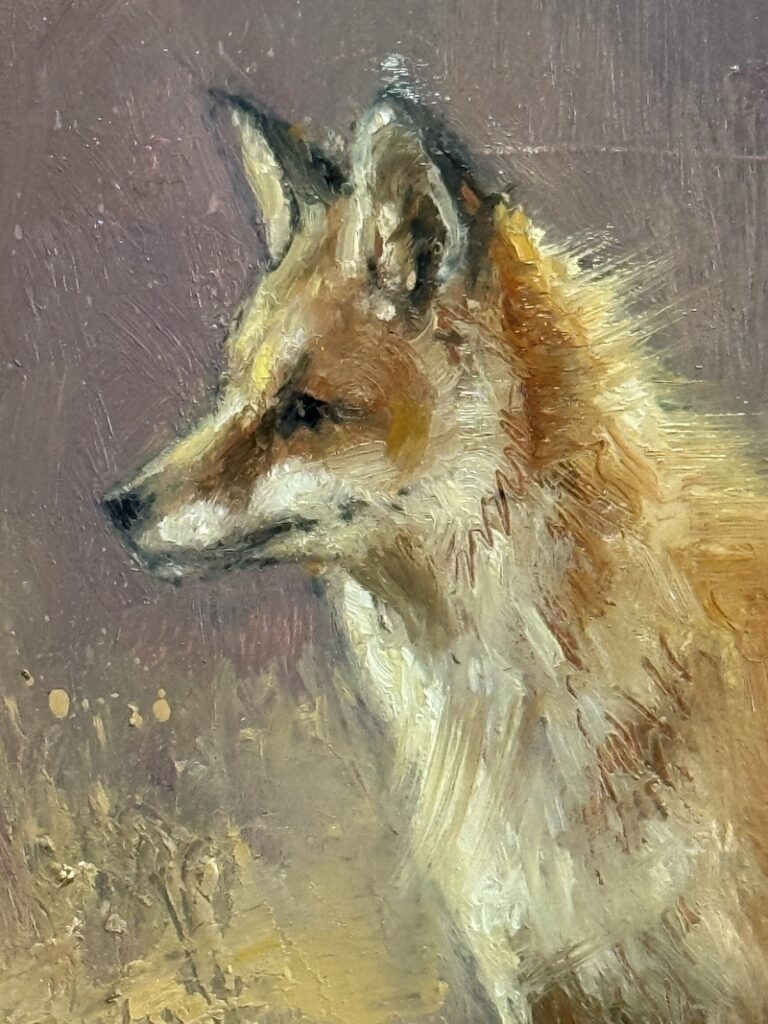
On a small painting, the tiniest shift can throw off the whole piece. For instance, the fox taught me a lesson… every time I “corrected” him, his ears kept getting bigger and bigger!
Starting over gave a clean reset, and the proportions snapped back into place.
5) Overworking Happens Instantly
Small paintings can go from fresh to muddy in minutes. The danger is that “fixing” often becomes the problem!
The Truth: Small Paintings Make You Stronger
As frustrating as tiny paintings can be, there’s a big upside. Small paintings sharpen your skills fast.
They force simplification. They train the eye. They teach better control of edges and values. Plus, they strengthen decision-making. Any hesitation reflects quickly on a small substrate.
The bonus is that small paintings are a safe place to experiment. New ideas can be tested, brushwork can be explored, and risks feel less intimidating than on a 40×30.
A Few Tips to Survive (and Even Enjoy) Tiny Paintings
If small paintings have been giving you trouble, these tips help:
-
Keep shapes larger than you think you need. In other words, avoid getting fussy too soon.
-
Choose one area to stay sharp. Then let everything else diffuse and breathe.
-
Don’t chase detail. Suggest more, describe less.
-
Stop sooner. Fresh is best.
-
Walk away and come back. Fresh eyes solve more than more paint.
-
If unsure, let it dry before “fixing.” Dry paint gives you a safety net.
A Quick Note About Pricing Small Paintings
One question often comes up: “If a small painting takes longer than usual, should I charge more?”
In most cases, the answer is no. Consistent pricing builds trust with collectors and keeps your pricing structure clean and easy to understand. After all, buyers aren’t purchasing your number of hours; they’re investing in the finished piece and the experience it gives them.
Here’s the funny part: pricing works a lot like painting.
On a small painting, every brushstroke shows… and pricing can feel the same way.
On a large piece, raising the price by $100 barely registers because it’s a tiny shift inside a big number. But on a small painting, that same $100 jump feels much louder, and collectors will notice.
That’s why consistent pricing for small work can be a smart strategy. It keeps the “read” clean for collectors and lets the art speak without the price becoming a distraction, like an extra bold brushstroke in the middle of a delicate passage.
The Takeaway
Small paintings may be small… but they are mighty. They can be stubborn, dramatic, and wildly demanding. At the same time, they teach big lessons, and when they finally click into place, they feel like a little gem.
So, if a miniature painting is giving you trouble, stick with it. More often than not, that tiny canvas is simply keeping you honest.
Because the little ones? They really do have nowhere to hide.